
Los Angeles teeters on the brink of bankruptcy
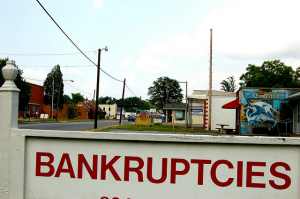 Editor’s Note: This is the Tenth in a CalWatchDog.com Special Series of in-depth articles on municipal bankruptcy
Nov. 13, 2012
By Brian Calle
Taxpayers in Los Angeles are facing a major crisis if Mayor Antonio Villaraigosa and other officials do not begin to address the systemic, structural issues putting the city on the fast track to economic upheaval. The situation is similar to that in other California cities such as Stockton and Vallejo.
The tsunami of unfunded pension liabilities and health benefits is about to hit the shoreline of Los Angeles. And if Stanford University’s estimates are correct, Los Angeles is facing roughly $27 billion in unfunded pension liabilities. For a city whose annual budget is in the $7 billion range this year, that figure is daunting.
The Big Budget Picture
Budget gaps are no rarity for the City of Angels in recent years. It seems like an annual tradition. In fiscal year 2011-2012, the city projected a budget shortfall of more than $400 million. For 2010-11’s fiscal year, the tune was the same. As was 2009-10, and so on.
L.A.’s chief administrative officer, Miguel Santana, noted that the budget shortfall is likely to be much greater by 2014-15. “Every year it gets worse,” he said.
The chain of events is always the same. City officials announce a budget shortfall and the mayor seeks to bandage it with gimmicks that fail to address the underlying causes.
Criticizing Villaraigosa’s approach to last year’s budget shortfall, City Controller Wendy Greuel said that ”kicking the can down the road is not a solution when we can anticipate a growing structural deficit in future years.” She was referring specifically to a plan Villaraigosa outlined to borrow money to solve part of the deficit. But her summation applies to the inept budgeting approach of the city for years.
Former Los Angeles Mayor Richard Riordan predicted increased hardships and eventual bankruptcy if drastic action wasn’t taken by city officials. In an editorial he penned in the Wall Street Journal in 2010, he wrote, “Los Angeles is facing a terminal fiscal crisis: Between now and 2014 the city will likely declare bankruptcy.”
Riordan is not shying away from those comments. In a recent phone conversation, he told me that bankruptcy for L.A. could come “as early as next year.”
Ballooning Pension Costs
What has rapidly perpetuated financial woes for the city is that payouts for retirement benefits have increased in recent years, thus crowding out services the city provides. A study released in early April by the Stanford Institute for Economic Policy Research found that, for the city of Los Angeles, “Pension costs increased from 8.5 percent of total city expenditures in 1999 to 13.7 percent in 2011.” For fiscal year 2011-12, estimated pension costs look to have climbed to “15.4 percent of city expenditures.”
Stanford’s study also estimated that each of the city’s three independent pension funds is unfunded by billions of dollars: the city of Los Angeles Fire and Police Pension System is $9.25 billion unfunded; the Los Angeles City Employees’ Retirement System is $11.32 billion unfunded; and the city of Los Angeles Water and Power Employees’ Retirement System is $6.59 billion unfunded.
“In 1999, Los Angeles City’s aggregate annual required contributions for its three systems totaled $291 million, rising to $923 million in 2011, an annual average growth rate of 11.1 percent,” according to the Stanford report.
But here is the kicker: The growth in pension spending by the city “outpaced that of spending on public protection, which grew at 5.2 percent, on health and sanitation (3.6 percent), and on recreation and cultural services (5.8 percent), and it occurred while spending on public assistance programs fell by an average of 3.0 percent per year.”
If the trend continues, the city will be little more than a professional retirement payment and processing service.
Union Power
Economic downturn aside, interminable spending fueled by powerful unions has pushed Los Angeles to the brink of bankruptcy. As Riordan argues, unions basically control the Los Angeles City Council.
For example, “A compensation package negotiated in 2007 irresponsibly guaranteed many city workers more than 25 percent in pay hikes over five years,” according to a Los Angeles Times editorial.
And as the city continues its downward spiral, “most employees represented by the Coalition of Los Angeles City Unions are scheduled for 11 percent increases in compensation over the coming two years,” the Times reported.
One of the ideas for offsetting some of this year’s budget shortfall was to ask city workers to forgo raises. But the union bosses balked at the idea, claiming that city employees had sacrificed enough in recent years.
As for pension benefits, some city employees are able to retire with up to 100 percent of their salaries, a benefit virtually unheard of in the private sector.
Triggering Bankruptcy
“What will likely trigger bankruptcy is when Wall Street stops buying bonds from [the city of] L.A.,” Riordan told me. “Someone will wake up and say, ‘They aren’t going to have enough money to pay off my bonds,’ and that will be that.”
“If you predict ahead three or four years,” Riordan argued, the city will have to “close parks, libraries and cut police and fire services,” similar to what has happened in the cities of Stockton and Vallejo.
Tap Dancing Around Reform
According to KABC, “Mayor Antonio Villaraigosa says the city has cut a third of the general fund civilian workforce” in recent years.
Of course, layoffs will not be enough, and Villaraigosa has argued that city workers will have to assume more costs for their own health care. And he has announced plans for changes to the city’s pension system, including raising the retirement age for new hires to 67 (current workers retire at 55 or 60) and limiting pension benefits so that retirees cannot retire with 100 percent of salary.
Union leaders instantly chastised the mayor for his pension proposals, specifically his plan to raise the retirement age. But frankly, his proposals barely scratch the surface of what’s necessary for fiscal sustainability.
At the very least, a new, less-generous pension plan has to be created for new employees, something like the 401(k) plans private sector employees have. Jan Perry, a Los Angeles city councilwoman and candidate for mayor, told me, “A new pension tier for people not even hired is completely reasonable to pursue.”
Pension expert Marcia Fritz said that all of the city’s employees should pay at least half of pension costs. “This eliminates the employer paid pension contribution and will reduce pension costs as a whole,” she said.
“Another thing L.A. should do,” if bankruptcy becomes reality, “is break retiree health contracts,” she said. “They weren’t prefunded, so are empty promises, and courts have allowed retiree health to be lumped in with other unsecured creditors.”
The best option would be to adjust promised benefit levels for current workers. Some experts believe, as Fritz also noted, that “fiscally distressed agencies may have the ability to adjust benefits for current workers.” She argued that there is a growing precedent that governments can call on employees to increase retirement contributions and suspend cost-of-living increases when municipal or agency funds are at unhealthy levels. Still, these necessarily bold approaches are untested.
Of course, another option to fix the hole would be astronomical tax increases, which would likely only delay real solutions. Riodan balked at the idea, asking, “Can you imagine L.A. quadrupling their taxes? Everyone would flee the city and the state.”
Even with the city’s challenges, as hard is it may be to believe, Riordan contended: “L.A. is better off than a lot of cities” in California and elsewhere. If that’s the case, there is a bumpier road ahead.
Calle is the editor-in-chief of CalWatchDog.com, the investigative journalism bureau of the Pacific Research Institute.
Related Articles

Video: Peter Schiff on economic collapse
Can American economic policies continue failing? Will California’s real estate always go up? Interviewed by CalWatchDog.com’s James Poulos, Peter Schiff

What Budget Crisis?
Mar. 19, 2010 I spend my days attending state Assembly and Senate committee hearings, trying to follow proposed legislation. Most
Do 57 percent really want higher CA property taxes?
Feb. 1, 2013 By Wayne Lusvardi A new public opinion poll reported 57 percent of all California “adults” would favor
